
Home » Uncategorized (Page 22)
Category Archives: Uncategorized
Sheriff Adopts Latest Forensic DNA Technology with M-Vac
New DNA Collection Method Can Help Solve More Crime
COLUMBIA, SOUTH CAROLINA (PRWEB) March 28, 2016
Richland County Sheriff Leon Lott announced that the Richland County Sheriff’s Department has adopted a new forensic DNA collection method that will help solve crimes. The Department is the first crime lab in South Carolina to acquire the new, wet-vacuum based forensic DNA collection method.
“This new equipment has helped solve criminal investigations in a number of areas of the US that were otherwise stalled or had gone completely cold,” States Sheriff Leon Lott. “The cutting edge technology, called the M-Vac System, has been shown to collect significantly more DNA material when compared to traditional methods, often times enabling more DNA information to be generated.” Richland County Sheriff’s Department investigators and expert criminalists want to initially use the M-Vac on cold cases and violent crimes, but will utilize the M-Vac System wherever appropriate to help generate better DNA results to move a case forward.
“We’ve been researching this collection method for some time, but only got a first hand look at it recently and just started testing it this month,” says Rachel Grant, DNA Technical Leader of the Richland County Forensic Laboratory. “Now that we have validated the M-Vac System ourselves, we are totally comfortable adopting it into our DNA collection processes, and are eager to use it in actual case work samples; especially on the more challenging evidence where DNA collection is most difficult. We are confident this new system will help our agency get DNA results where they may not have been achievable before, and that will be a good investment for our community.”
By implementing this new collection method, Richland County Sheriff’s Department is being proactive in the growing field of forensic DNA and improving its overall capability to solve crimes. Along with other lab technologies and training the Richland County Sheriff’s Department has positioned itself as one of the most capable labs in the country, able to offer a distinctive service that is not currently available in the surrounding area. Last year the M-Vac was instrumental in helping a previously unsolved murder case in Salt Lake City. That case and trial, combined with the data from agencies like the Philadelphia Police Department and research results from Boston University and University of California Davis, demonstrates the strength of the system.
“The bottom line is the M-Vac System helps investigators solve more crime,” states Jared Bradley, President of M-Vac Systems. “The Richland County Sheriff Department is a large agency with a significant population and responsibility, so solving cases as quickly and efficiently as possible is critical. We are excited to partner with the Sheriff’s Department and applaud their willingness to lean forward in adopting new technologies such as the M-Vac. In the last year the M-Vac has produced DNA profiles from bricks, cement, rocks and all kinds of fabrics even after the other methods had failed, so we are confident the Richland County Sheriff’s Department will get similar results. We’re also beyond impressed with how quickly they have moved in validating and employing their system. What has taken other labs years to accomplish RCSD has done in less than a month. The Department and the community should be proud of that.”
“This is another example of how the Richland County Sheriff’s Department lab prides itself on being among the first in the nation to use cutting edge technology to help solve crimes,” States Sheriff Lott. “This is important to not only identify and bring those responsible to justice, but it helps to bring closure to those families involved.”
Contacts:
Lt. Curtis Wilson
Public Information Officer
803-576-1429
cuwilson@rcsd.net
For Original Press Release Click here.
Richland County Sheriff – M-Vac System Validation
The M-Vac is a swab-free collection system that retrieves particles from substrates and concentrates them onto a filter. This wet vacuum system collects DNA by directly spraying a DNA free solution onto a surface. It creates a ‘mini’ hurricane to loosen present DNA material, followed by and concentrating onto a filter that is subjected to DNA analysis. The M-Vac is able to collect DNA from large areas, textured, porous, and rough substrates that typically present themselves as challenges during routine casework.

Four (4) different substrates were prepared and processed with both a traditional DNA collection technique (scraping and/or swabbing) and the M-Vac System. Each substrate was designed to mimic true evidence that laboratory personnel encounter during routine casework. Each substrate was divided into two equal parts, the left side subjected to a traditional collection technique and the right side subjected to the M-Vac. All samples subsequently underwent extraction (Qiagen® EZ1 DNA Investigator Kit), quantitation (Investigator® Quantiplex HYres Quantitation Kit), amplification (Promega® PowerPlex Fusion), and capillary electrophoresis for separation and detection. The prepared substrates are listed as below:
Item 1: Saliva
T-shirt (New)
A 1:10 saliva dilution was created and evenly distributed (~20 strokes) across the front of the shirt with a sterile swab.
Item 2: Touch
T-shirt (New)
An individual forcibly grabbed and pulled shirt up around the collar, on the front, and under the arms after wearing nitrile gloves for several minutes.
Item 3: Negative control
T-shirt (New)
A new, clean t-shirt directly out of a Hanes® plastic package.
Item 4: Touch
Brick (New)
A brick was held for approximately 5 minutes prior to being forcibly thrown.
Results:
The M-Vac retrieved higher concentrations of DNA from items 1, 3, and 4 than the traditional DNA collection technique (Table 1). The concentration from the M-Vac collection for item 2 was lower than the traditional method however the M-Vac sampling yielded a more informative DNA profile. Item 2 yielded an additional male profile in conjunction with the expected female profile generating a mixture. The negative controls exhibited one allele from the scraping/swabbing collection technique and nine alleles with the M-Vac sampling technique; however, both results are too weak to be reliably interpreted. The amount of DNA recovered from item 4 using the M-Vac was approximately 30x times more than the traditional collection techniques and yielded a full DNA profile whereas the traditional collection method only yielded two alleles (Table 2). The M-Vac consistently retrieved more DNA versus the traditional methods and is therefore a sufficient DNA collection system for porous, textured or rough substrates.
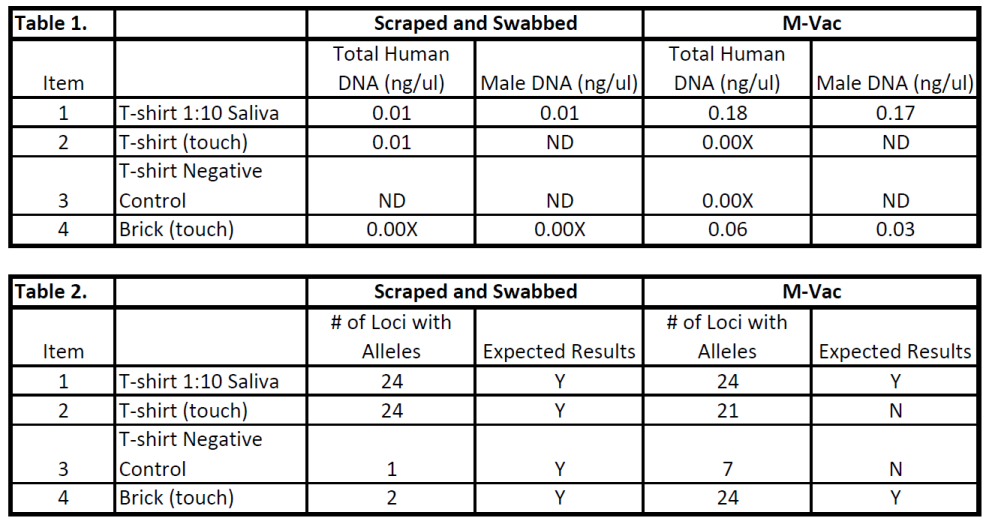
Courtesy of Richland County Sheriff’s Department. The validation was developed, conducted, analyzed and written by Richland County Sheriff’s Department personnel.
http://m-vac.com/why-mvac/validation-trials/richland-county-sheriff—validation
 mvacblog